 Book now
The Camera degli Sposi: Mantegna's Painted Chamber
The story of Andrea Mantegna's Camera degli Sposi — the illusionistic oculus, the two great court scenes, and why this small room changed European painting.
A single corner room in a moated castle holds one of the turning points of Western art. This is the story of Mantegna's Camera degli Sposi — what you are looking at, and why it matters so much.
A commission for Ludovico Gonzaga
In the 1460s Ludovico III Gonzaga, Marquess of Mantua, set his court painter to work on a small upper room in the Castello di San Giorgio. That painter was Andrea Mantegna, already famous for a hard, sculptural precision that made painted figures look carved from stone. Mantegna worked on the room, then called the Camera Picta or 'painted chamber', between 1465 and 1474 — nearly a decade for a single space — and signed and dated it on a painted scroll. The Gonzaga were not the grandest dynasty in Italy, but they were ambitious and cultured, and Ludovico understood that a room like this could speak for the family more eloquently than an army. What Mantegna delivered was both a group portrait of the ruling house and a demonstration of what the new art of perspective could do. The later nickname 'Camera degli Sposi', the room of the bride and groom, attached itself over time, though the frescoes are really about dynasty and continuity rather than any single wedding. Ludovico had lured Mantegna to Mantua in 1460 with a salary, a house and the promise of steady work, and the painter would remain the Gonzaga court artist for the rest of his life, a rare and telling loyalty. The Camera Picta was his great early statement for the family, and its slow completion over nearly ten years reflects both Mantegna's exacting method and the interruptions of a working court. When you stand in the room you are therefore looking not at a quick decorative commission but at a decade of one of the sharpest minds of the Renaissance, concentrated on a single space meant to impress ambassadors, allies and rivals with the dignity and permanence of Gonzaga rule.
The court on the walls
Two of the room's walls carry the great figural scenes, and their calm realism still startles. On the north wall the Gonzaga gather as if paused mid-moment: Ludovico himself, seated, turns to speak; his wife Barbara of Brandenburg sits composed beside him; their children, courtiers, a favourite dog and a court dwarf fill the space with unidealised, individual faces. On the west wall unfolds 'The Meeting', in which Ludovico greets his son Francesco, newly raised to cardinal, against a background of an imaginary, gleaming city that blends Rome and Mantua. Servants, horses and more portraits crowd the margins, and above run painted medallions of Roman emperors. These are among the first group portraits in European art to feel genuinely observed rather than posed to a formula, and generations of visitors have felt, standing among them, less like spectators than like guests who have walked into a private family gathering five centuries ago. Look closely and you will notice how carefully the scenes flatter without lying: the faces are individual, sometimes plain, and all the more convincing for it, so the family's magnificence seems reported rather than invented. Scholars still debate exactly who each figure is and what moment is depicted, which only adds to the fascination of standing before them. There is warmth here too — a child leaning against a parent, the famous dog beneath the throne, the ordinary intimacy of a great household — that makes the Gonzaga feel startlingly present. Few images from the fifteenth century let you meet a ruling family so directly, eye to eye, across five centuries.
The oculus: a hole in the sky
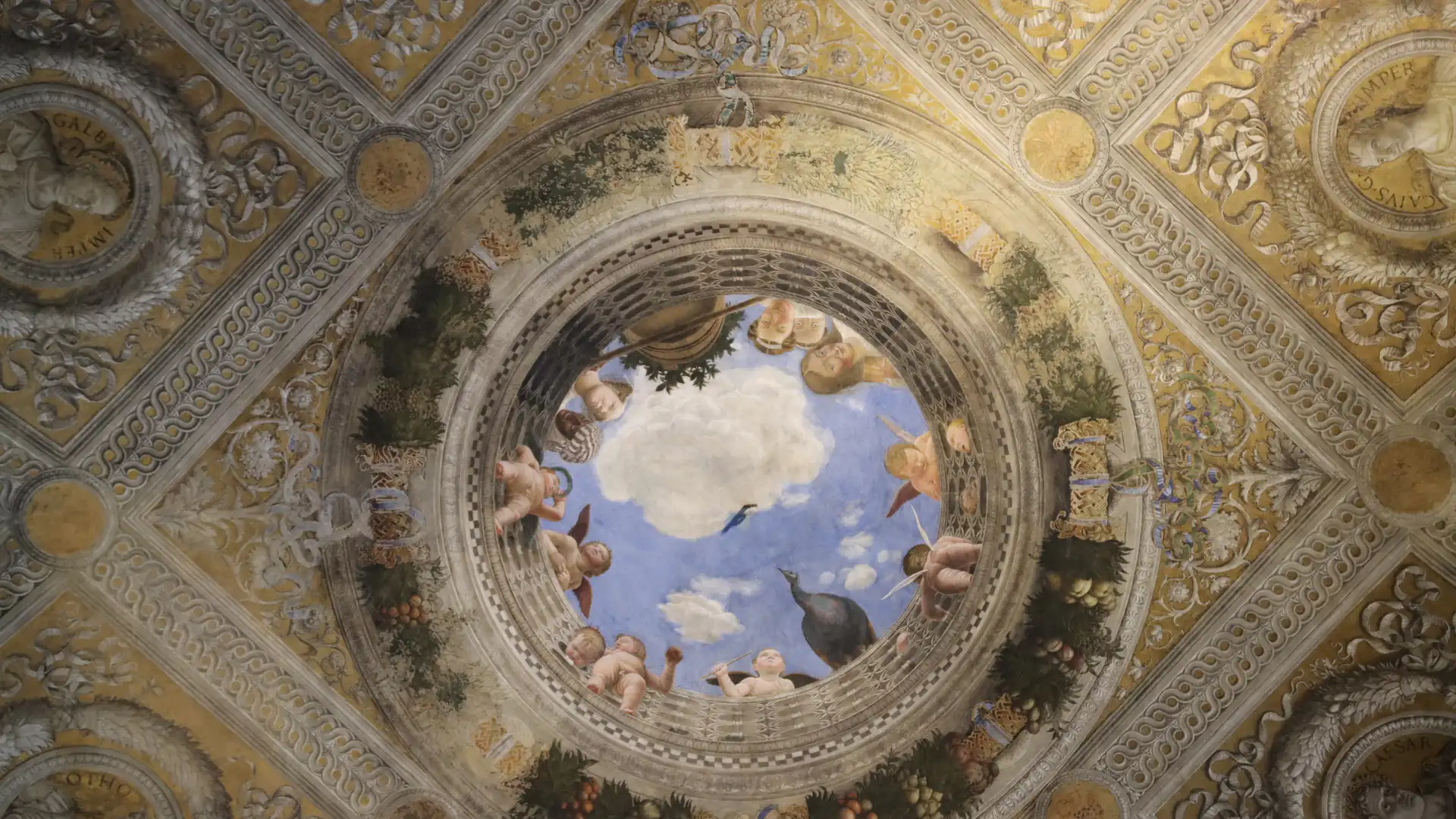
Then you look up, and the room performs its miracle. At the centre of the ceiling Mantegna painted a circular opening — an oculus — apparently giving onto a bright open sky, ringed by a balustrade. Leaning over that balustrade and peering down at you are smiling women, a turbaned figure, chubby putti squeezing through the rails, and a peacock, while a precariously balanced tub of plants threatens to tip over the edge. It is entirely painted, entirely flat, and entirely convincing: the first fully resolved example of di sotto in sù, the art of painting a ceiling as if seen sharply from directly below. Before this, ceilings held patterns or floating figures; Mantegna made the roof seem to vanish. The idea was so powerful that it echoes through the next three hundred years of European art, from Correggio's domes in nearby Parma to the vast illusionistic ceilings of the Baroque. In one small room in a provincial castle, painting learned to open the sky. The wit of it is as striking as the skill. This is not a solemn heaven but a playful one, full of everyday mischief — the tub of foliage balanced on a pole that seems about to crash down into the room, the putti daring each other through the balustrade, the women exchanging glances as they look at you looking at them. Mantegna made the grandest technical breakthrough of his career and chose to leaven it with humour, which is part of why the ceiling delights people who know nothing of perspective theory. You do not need the art history to feel the floor of the sky give way; the room simply works on everyone who walks in and looks up.
How Mantegna achieved the illusion
The magic rests on relentless craft. Mantegna was a master of linear perspective and of foreshortening — drawing forms as they truly appear when tilted sharply away from the eye — and he applied both with almost mathematical rigour. For the oculus he imagined a single viewpoint at the centre of the floor and constructed every rib of the balustrade, every foreshortened cherub and dangling foot, to be correct from that spot. He worked much of the room in true fresco, painting into wet plaster so the colour bonded with the wall, and added fine detail and gilding afterwards. The whole chamber is knitted together by painted architecture — pilasters, vaults and swags that pretend to be carved and structural — so the real and the illusory blur at every join. The result is not merely clever; it is beautiful, and it repays the few minutes you are given. Knowing how deliberately it was built only deepens the pleasure of standing at the centre and watching the ceiling seem to lift away above your head. He also understood light. The painted architecture is lit as if by the real windows of the room, so the illusion holds together as your eye travels from solid wall to fictive vault, and the whole space reads as one continuous, believable interior. Mantegna's training in the tough, archaeologically minded workshops of Padua gave him both this obsession with correctness and a deep love of antiquity, which is why the room is studded with classical detail — medallions of Caesars, Roman-style swags and reliefs — that frames the very contemporary Gonzaga as heirs to imperial dignity. Craft, in other words, is never merely technical here; every device is bent toward a message about the family that paid for it.
Why the visit is so brief
The very fame of the Camera degli Sposi is also its vulnerability. Frescoes are sensitive to humidity, temperature and the simple breath and body heat of crowds, and this one is more than five centuries old. To keep it safe, the operator strictly limits access: entry is capped at around 1,500 visitors a day, and people are admitted in small groups of roughly twenty-five for about five minutes each. That is why the whole palace runs on timed slots. Five minutes can sound short, but it is enough — the room is small, and with a booked slot you enter calmly, look up, take in the court and the ceiling, and leave with the image burned in. The limits are not bureaucracy for its own sake; they are the reason the room still looks as it does, and the reason it will still be there for the next generation of travellers. Booking ahead simply guarantees you are one of the fortunate few hundred who get in on your day. It is worth carrying a little gratitude into the room on that account. Countless frescoes of comparable age have been dimmed, damaged or lost precisely because they were not protected in time, and the strictness that governs the Camera degli Sposi is the reason this one still glows. So rather than resent the clock, use it: decide before you enter what you most want to see, step in, look up first, then let your eyes fall to the walls. Five focused minutes under Mantegna's ceiling leave a sharper memory than half an hour of distracted wandering would, and you leave knowing you have seen it as clearly as conservation allows.
What to look for in your few minutes
Because your time in the chamber is short, it helps to know where to look. Start with the ceiling oculus and find the individual characters — the peacock, the tipping planter, the putti threaded through the balustrade, the faces smiling down — because that is the detail people most regret rushing past. Then bring your eye to the north wall and read the family group: notice how Mantegna distinguishes each face, the tenderness and stiffness of real people rather than types. Turn to 'The Meeting' and pick out the dream-city in the background and the ranks of portraits and horses. Glance, too, at the painted architecture that frames everything, and at the emperors' medallions overhead. Do not worry about reading every scene in five minutes; let the room wash over you first, then chase two or three details. Many visitors say the memory that stays is simply the sensation of the ceiling opening — so give yourself a moment, head tilted back, to feel the sky that Mantegna painted into a castle roof. If you are visiting with children, turn the ceiling into a game of spotting the peacock, the falling planter and the cheeky putti, and they will remember the room long after they have forgotten grander sights. Art lovers might instead trace how the painted architecture pretends to be structural, and where Mantegna cheats the geometry just enough to make the illusion read from anywhere in the room rather than only from the exact centre. Whatever your angle, resist the urge to spend your whole five minutes behind a phone screen; the room rewards direct looking far more than photography, and the image you carry away in your own memory will be the better one.
The room in the story of art
It is hard to overstate how far the Camera degli Sposi reaches. Mantegna's illusionistic ceiling gave later painters permission to treat a vault as a window onto infinite space, and the lineage is direct: Correggio in Parma, then the great ceiling-painters of the Roman Baroque, and ultimately the swirling heavens of countless churches and palaces across Europe. The two wall scenes, meanwhile, advanced the group portrait toward the naturalism that would define the following centuries. That such an influential work survives in place, in the very castle for which it was made, rather than scattered to distant galleries, is part of what makes a visit so moving — this is not a fragment behind glass but a whole room, experienced as its patrons experienced it. Seeing it in Mantua also sets it in context: the Gonzaga court that commissioned it, the palace that grew around it, and the city that the family made. Come for the ceiling, and you leave understanding a turning point in how Europe learned to see. There is also something to be said for seeing it in its home town rather than in reproduction. The Camera degli Sposi has been copied, printed and analysed endlessly, yet none of that prepares you for the scale, the colour and the strange intimacy of the actual room, small enough to fill your whole field of view. That it has never been moved — that you stand where Ludovico's guests stood — collapses the distance between the fifteenth century and your own visit in a way no gallery display can. It is, in the end, both a lesson in the history of art and simply one of the most purely delightful rooms ever painted, and the few minutes you are given are enough to feel both at once.
Frequently asked
Who painted the Camera degli Sposi and when?
Andrea Mantegna painted it between 1465 and 1474 for Ludovico III Gonzaga, in the Castello di San Giorgio at the heart of the Palazzo Ducale di Mantova. He signed and dated the finished room.
What is the famous oculus?
It is the painted circular opening at the centre of the ceiling, giving the illusion of an open sky ringed by a balustrade, with figures, putti and a peacock looking down. It is the first fully convincing di sotto in sù ceiling in Western art.
Why can I only stay about five minutes?
To protect the fragile fresco from humidity and crowding, visitors enter the Camera degli Sposi in small groups for roughly five minutes, with a daily cap of about 1,500 people. This is why the whole palace uses timed slots.
Can I photograph the room?
Photography without flash is generally permitted, but the rules are stricter inside the chamber, where custodians manage each short visit. Flash, tripods and selfie sticks are not allowed; please follow the custodians' instructions.