 Book now
Inside the Palazzo Ducale di Mantova: Room by Room
Beyond the Camera degli Sposi — the Castello di San Giorgio, the Corte Vecchia and Pisanello, Isabella d'Este's studioli, Giulio Romano's halls and Santa Barbara.
The Camera degli Sposi is the reason most people come, but it is one room in a palace of more than five hundred. Here is what else to seek out as you walk the Gonzaga's city of one.
A palace grown over four centuries
The Palazzo Ducale is really several palaces fused together, and part of its fascination is watching the styles change as you walk. It began with the medieval Corte Vecchia — the Magna Domus and the Palazzo del Capitano — raised when the Bonacolsi and then the Gonzaga first held Mantua. The Gonzaga added the moated Castello di San Giorgio at the end of the fourteenth century, then, in the Renaissance, the Corte Nuova and a sequence of grand apartments, galleries and gardens, along with their own palatine church. By the family's height the complex sprawled to more than five hundred rooms around eight courtyards and seven gardens, connected by corridors and hanging passages — a self-contained world where the dynasty could live, worship, govern and display its wealth without stepping outside. Walking it today, you move from Gothic gloom to Renaissance light to Mannerist bravado in the space of an afternoon, reading four centuries of ambition in stone and plaster. Knowing the rough order of building makes the whole visit easier to follow. Because it grew rather than being designed all at once, the palace has no single grand plan to follow, and first-time visitors sometimes feel gently lost — which is part of its character. The trick is to stop trying to map it and instead let the changing rooms tell the story: heavy medieval masonry gives way to airy Renaissance proportion, then to the deliberate, rule-breaking theatre of Mannerism, as one century of Gonzaga hands the building to the next. Corridors, courtyards and hanging passages stitch it all together, and every so often a window opens onto the lakes to remind you that this whole world was built on the water. Follow the marked route and the sprawl resolves into a sequence you can enjoy rather than decode.
The Castello di San Giorgio
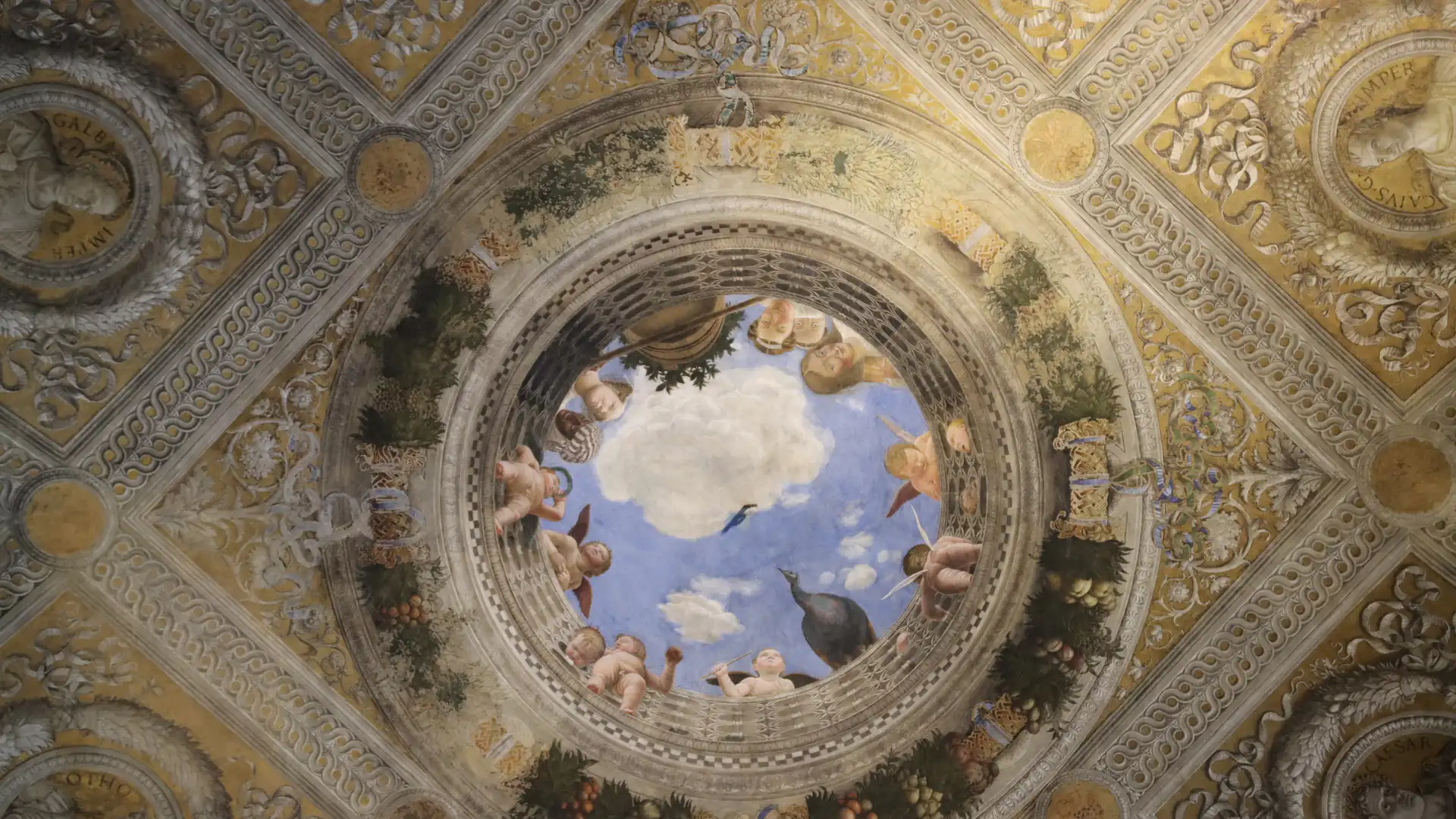
The moated Castello di San Giorgio anchors the complex and holds its greatest treasure. It was built between 1395 and 1406 by the military architect Bartolino da Novara for Francesco I Gonzaga, a square block with four tall corner towers guarding the city's approach from the lakes. Conceived as a serious fortress, it was gradually converted into a residence as the Gonzaga's rule grew secure, its defensive rooms turned into apartments. It was here, in an upper corner chamber, that Ludovico III had Mantegna paint the Camera degli Sposi, so the castle that began as a statement of military power ended as the setting for a statement of cultural power. Approaching across the old bridge line, with water still on two sides, you get a vivid sense of how the fortress once loomed over the waterway. Inside, beyond the famous room, the castle's thick walls and stairs are part of the experience — a reminder that Renaissance splendour here was layered onto genuine medieval defence. The castle's four towers and encircling water were once the hard edge of Gonzaga power, and even softened into a residence it never quite loses that martial gravity. That contrast is one of the quiet pleasures of the visit: you pass through spaces built to withstand a siege on your way to a room built to delight ambassadors, and the two purposes sit only a few metres apart. Restoration work over the years has stabilised the fabric and, at times, closed sections in rotation, so the exact route through the castle can vary; the constant is that this is where Mantegna's chamber waits, and the approach across the old bridge line, water glinting on either side, is a fittingly dramatic prelude to it.
The Corte Vecchia and Pisanello's Arthurian fresco
The oldest wing, the Corte Vecchia, holds one of the palace's most romantic surprises. In a large hall, hidden for centuries beneath layers of plaster and only rediscovered in 1969, are the remains of a fresco cycle by Pisanello, the great late-Gothic painter, depicting knights, tournaments and a battle drawn from the Arthurian romances that entranced the fifteenth-century courts. Left unfinished, it survives partly as finished painting and partly as ghostly underdrawing — the sinopie sketched straight onto the wall — which lets you watch a master at work mid-thought. There is nothing else quite like it in Italy: a glimpse of the chivalric fantasy world the Gonzaga liked to imagine themselves inhabiting, all armour, horses and courtly drama. Because it was lost for so long and found so recently, many visitors do not expect it, which makes stumbling on it all the more memorable. Give the room time, and let your eye travel between the painted passages and the exposed drawing beneath. The Pisanello room is also a lesson in how much of the past survives only by luck. Plastered over and forgotten for centuries, the cycle came to light almost by accident in the twentieth century, and what we see now is a fragment of a far larger scheme that was never finished. That incompleteness is oddly moving: you can read the artist's intentions in the bare underdrawing as clearly as in the painted armour and horses, as though the work had been paused mid-sentence. For anyone interested in how pictures were actually made — plotted, sketched, then painted — it is one of the most instructive rooms in Italy, and its subject, the doomed chivalry of the Arthurian world, gives it a wistful romance that lingers.
Isabella d'Este and her studioli
No figure haunts the palace more than Isabella d'Este, who married Francesco II Gonzaga in 1490 and became the most celebrated art patron of the Renaissance — courted by artists, envied by rival courts, and painted by Titian and Leonardo. Within the Corte Vecchia she created her private apartments, including the Studiolo and the Grotta, small rooms designed to hold her collection of paintings, antiquities and precious objects and to serve as a retreat for study and conversation. She commissioned allegories from Mantegna, Perugino, Lorenzo Costa and others specifically for these walls; most of those pictures now hang in the Louvre and elsewhere, but the intricately carved and inlaid rooms themselves remain. Even stripped of their masterpieces, the studioli are deeply atmospheric — intimate, richly finished and unmistakably the domain of a formidable mind. They are also a corrective to any idea that the Renaissance court was only about men: here a woman shaped taste across Europe from a handful of jewel-like rooms. Isabella's letters, which survive in their thousands, show her bargaining, cajoling and occasionally bullying the greatest artists of the day to get exactly the works she wanted, and that force of personality still seems to inhabit the rooms she made. Her taste ran to the learned and the allegorical, and the studiolo and grotta were designed as a kind of intellectual jewel-box where painting, sculpture, antiquities and fine craftsmanship were gathered for private contemplation. To stand in them is to glimpse the private world of a woman who corresponded with popes and painters as equals, and who did as much as anyone to define what cultivated taste meant in Renaissance Europe. The paintings have gone to Paris; the ambition is still palpable in the woodwork.
Giulio Romano, the great halls and Santa Barbara
As the Gonzaga became dukes, they built to match. Federico II brought in Giulio Romano, Raphael's most gifted pupil, who from the 1530s shaped the Corte Nuova and left his stamp on grand, theatrical spaces such as the Sala di Manto and the Sala dei Cavalli, where painted horses seem to step from the walls. Later generations added the Sala dello Zodiaco, its ceiling scattered with constellations; the Galleria degli Specchi, a mirrored gallery; the long Galleria della Mostra; and the Sala dei Fiumi, with its playful painted grottoes and rivers. Duke Guglielmo built the family its own palatine basilica, Santa Barbara, between 1562 and 1572, complete with a celebrated organ and its own liturgy. Together these rooms show the Gonzaga performing sovereignty at full volume, in the confident, rule-bending language of Mannerism. After the concentrated intensity of the Camera degli Sposi, walking this sequence of halls is a different pleasure — expansive, decorative and endlessly inventive. Giulio Romano is the presiding genius of this later phase, and Mantua is really his city as much as the Gonzaga's — no other place shows his range so fully, from the official grandeur of the Ducale to the playful excess of Palazzo Te across town. In the state apartments his influence lends even the most formal rooms a sense of drama, of architecture and paint conspiring to overwhelm. Santa Barbara, meanwhile, reveals a different Gonzaga ambition: to run a court so complete that it had its own liturgy and its own sacred music, performed on one of the finest organs of the age. Between the secular halls and the ducal church, this stretch of the visit is the sound of a dynasty at the very peak of its confidence.
Curiosities: the dwarfs' apartment and the lost collection
A palace this large accumulates oddities. One of the most talked-about is the Appartamento dei Nani, the 'apartment of the dwarfs' — a warren of miniature rooms and a tiny staircase long romanticised as quarters built for the court dwarfs who appear in Mantegna's fresco. In truth it is most likely a scaled-down model of the Scala Santa, the holy staircase in Rome, built for private devotion; but the smaller, human story clings to it, and squeezing through its little spaces is genuinely strange and memorable. The palace also carries the shadow of a great loss: the Gonzaga once owned one of Europe's finest art collections, much of which was sold to King Charles I of England in the 1620s, and what remained was scattered when Imperial troops sacked Mantua in 1630. As you walk the grand but sometimes bare rooms, it is worth remembering that you are seeing the magnificent architecture of a collection that has largely flown — which makes the survivors, above all the Camera degli Sposi, all the more precious. The story of the lost collection is worth carrying through the rooms, because it changes how you read the palace. What survives is the superb architecture and the fixed decoration — the frescoes that could not be crated up and sold — while the movable treasures that once filled these walls, the Titians and Raphaels and Corregios, are dispersed across the museums of the world. The 1627 sale to Charles I and the sack of 1630 between them stripped the Gonzaga of their portable glory within a few short years, a fall as steep as any in Renaissance Italy. Knowing this, the Camera degli Sposi becomes doubly precious: it is the great survivor, the one masterpiece that could not be carried off because it is the very fabric of the room.
The Museo Archeologico and the gardens
Your ticket also opens the Museo Archeologico Nazionale housed within the complex, and it is well worth folding into the visit. Its galleries gather finds from Mantua and its territory across the ages — prehistoric, Etruscan, Roman and later — including material that roots the Gonzaga's Renaissance city in a far deeper past. It makes a quieter, cooler counterpoint to the painted splendour of the state rooms, and because it shares the ticket there is no reason to skip it if you have the time. Between the museums, the palace's courtyards and hanging gardens offer places to pause: the Cortile della Cavallerizza, the enclosed gardens, and the loggias that once let the court take the air with a view over the water. On a warm day these outdoor spaces are the natural spot to rest between the concentrated rooms. Taken together, the archaeology, the gardens and the state apartments explain why two to three hours passes so easily here — the Palazzo Ducale is less a single sight than a small world to wander. The gardens and courtyards also repay a slower look than most visitors give them. Designed as places for the court to walk, take the air and stage entertainments, they are an intrinsic part of how the palace was meant to be experienced — indoor magnificence relieved by green, shaded outdoor rooms open to the sky and, in places, the water. On a hot afternoon they are the perfect spot to sit for a few minutes and let the sheer quantity of what you have seen settle. Between the deep-time perspective of the archaeology, the calm of the gardens and the concentrated splendour of the state rooms, the Ducale offers not one experience but several, which is exactly why it rewards a generous two or three hours.
Frequently asked
What else is there to see besides the Camera degli Sposi?
A great deal: the Castello di San Giorgio, the Corte Vecchia with Pisanello's Arthurian fresco and Isabella d'Este's studioli, Giulio Romano's halls, the Sala dello Zodiaco, the basilica of Santa Barbara, the curious Appartamento dei Nani, and the Museo Archeologico — all on one ticket.
What is the Pisanello fresco?
An unfinished cycle of knights and a tournament drawn from Arthurian legend, painted in the 1430s and rediscovered under plaster in 1969. Parts survive as finished painting and parts as exposed underdrawing, which is part of its fascination.
Can I still see Isabella d'Este's art?
The rooms of her Studiolo and Grotta remain in the Corte Vecchia, but most of the paintings she commissioned are now in museums such as the Louvre. The carved and inlaid rooms themselves are still very much worth seeing.
Is the Museo Archeologico included in the ticket?
Yes. The Museo Archeologico Nazionale within the complex is covered by the same ticket, so you can visit it as part of your circuit at no extra charge.