The Palazzo Ducale di Mantova is less a palace than a walled city of one. For nearly four centuries it was the seat of the Gonzaga, the dynasty who ruled Mantua from 1328 to 1707, and over that time they knitted castles, courtyards, churches and apartments into a single complex of more than five hundred rooms, seven gardens and eight courtyards — one of the largest palaces in Europe. To walk through it is to move through the ambitions of an entire ruling house, room by painted room.
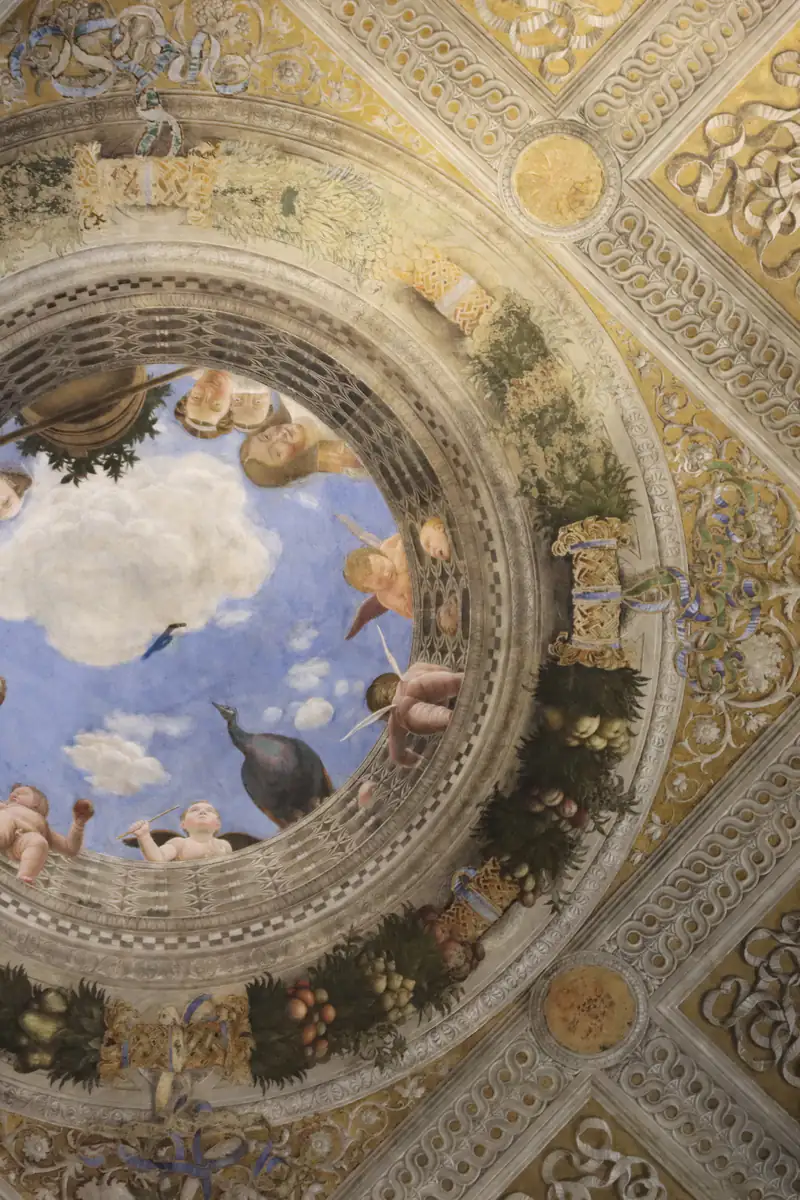
At its heart, inside the moated Castello di San Giorgio, is the reason most travellers come: the Camera degli Sposi. Between 1465 and 1474 Andrea Mantegna covered its walls and ceiling for Ludovico III Gonzaga, and what he achieved there changed European painting. The court gathers along the walls in calm, almost photographic groups, while overhead the ceiling opens into a painted oculus — the first fully convincing illusion of the kind — where cheerful figures and a peacock lean over a balustrade against a bright sky, as if the roof had simply dissolved.
Around that single famous chamber spreads the rest of the story. The medieval Corte Vecchia hides Pisanello's unfinished Arthurian battle and the studioli of Isabella d'Este, the most celebrated art patron of the Renaissance. Giulio Romano's Corte Nuova, the palatine basilica of Santa Barbara, the Hall of Mirrors and the Room of the Rivers all follow, each a chapter in the Gonzaga's long performance of power. The city of Mantua that surrounds it, ringed by three lakes, has been a UNESCO World Heritage Site since 2008.
We are a concierge service: you choose your visit date and entry window, we arrange and secure the timed ticket on your behalf, and it arrives in your inbox ready to show at the entrance. No wrestling with an unfamiliar booking system, no gamble on whether the fresco room still has slots — just your ticket, in English, in your email.