 Book now
How to Visit the Palazzo Ducale di Mantova
A practical guide to visiting the Gonzaga palace — opening hours, the timed Camera degli Sposi slot, the quietest times, how long to allow, and how to reach Mantua.
The Palazzo Ducale rewards a little planning: its star room runs on timed, capacity-limited entry, the complex is huge, and Mantua itself is worth a night. Here is how to time and shape your visit.
Opening hours and closing days
The Palazzo Ducale keeps the rhythm of an Italian state museum. It opens Tuesday to Sunday, from around 08:15 in the morning until about 19:15 in the evening, with last admission near 18:20 — a generous window that lets you pick your moment. The key closing day to remember is Monday: the whole complex is shut, every week, along with 1 January and 25 December. Because the museum is a working cultural institution, hours can occasionally shift for special events, ceremonies or restoration, and individual rooms in such a vast palace are sometimes closed in rotation. None of this needs to catch you out. When we arrange your dated ticket we confirm the opening for your day and flag any known closures affecting the parts you most want to see, so you are not standing on Piazza Sordello on a Monday wondering why the doors are shut. If your itinerary is fixed around a Monday, plan the palace for another day and use the Monday for Palazzo Te or the churches, which keep their own hours. A useful way to think about it is that Monday belongs to the rest of Mantua, not to the palace. Many travellers who find themselves in the city on a Monday spend it on Palazzo Te, the churches or a boat on the lakes, and save the Ducale for a day it is open. It is also worth remembering that last admission around 18:20 is the moment you must be inside, not the moment you can start heading over; give yourself comfortably more than that, because the complex is large and you will want unhurried time rather than a race against the closing bell in the final rooms.
How the timed entry works on the day
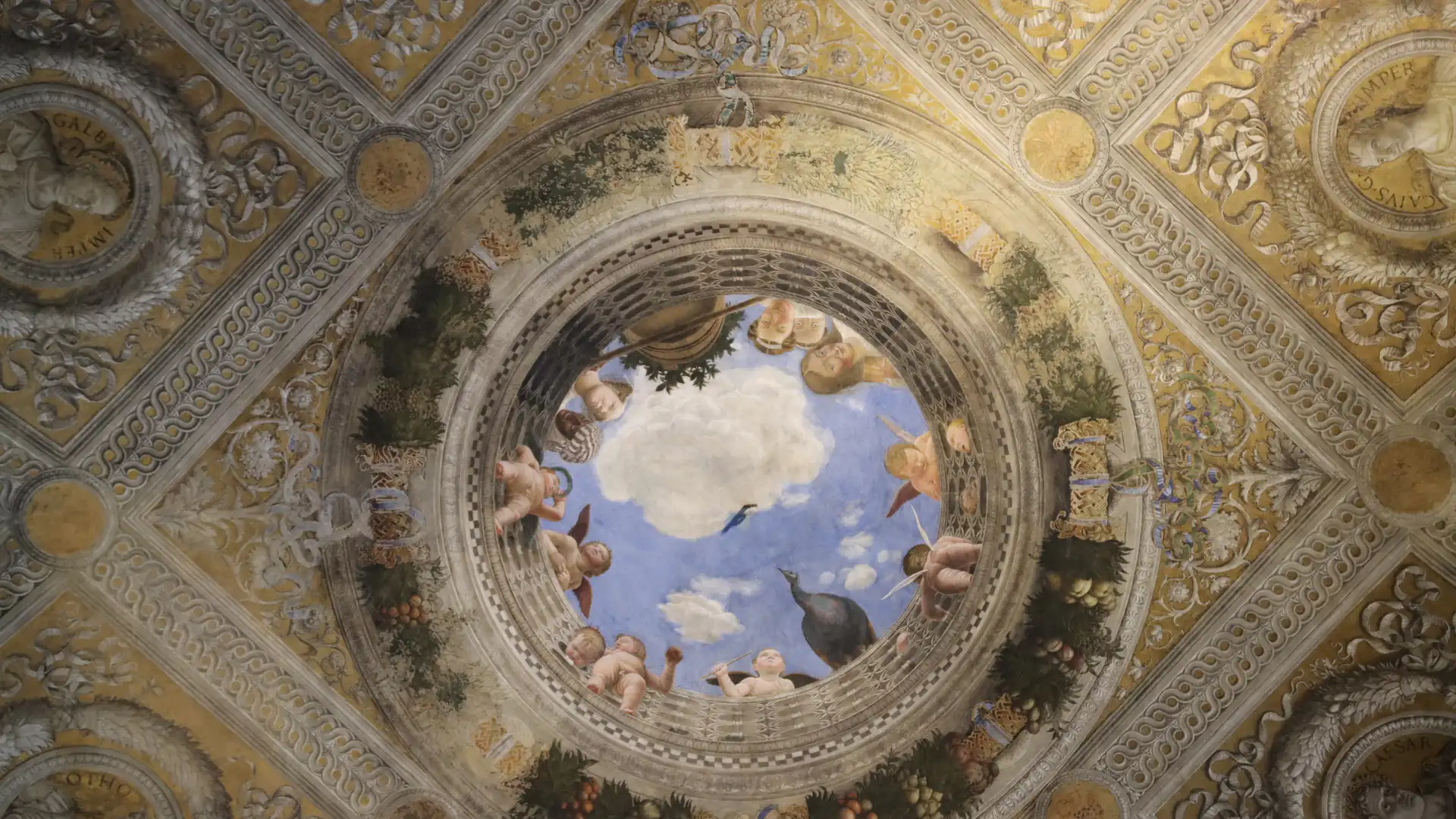
Your ticket carries a date and an entry window, and that window exists because of the Camera degli Sposi. To protect Mantegna's fresco, the operator lets only a small number of people into the room at once — around twenty-five — for about five minutes, and caps the day at roughly 1,500 visitors. On arrival, come to the main entrance a little before your window with your ticket ready. You will move through the palace and, at the appropriate point, be admitted to the Camera degli Sposi in your small group; the custodians manage the flow so everyone gets their few minutes under the painted ceiling. Outside that one room there is no clock on you: the rest of the palace and the Museo Archeologico are yours to explore at whatever pace suits you. The system sounds strict, but in practice it is what keeps the fresco room calm and viewable rather than crushed, and having a slot already booked means you glide through it instead of hoping for space. In practice, once you understand the reason for the system it stops feeling like a constraint and starts feeling like a courtesy — to you and to the fresco. The five minutes are unhurried when you are not also anxious about whether you will get in at all, which is precisely what a pre-booked slot buys you. Should anything about the flow be unclear on the day, the custodians are there to direct each group, and our concierge team is reachable in your language if a question comes up between the gate and the chamber. The vast majority of visits pass without a hitch; the timed system simply keeps the whole thing calm.
The best time of day and week
Timing your visit well makes a real difference in a palace this popular. Two windows are consistently calmer: the first hour after opening, around 08:15, before coach groups and cruise-excursion parties reach Mantua, and the last two hours before final admission, when the morning crowds have gone. The middle of the day is busiest, and weekends draw the heaviest local and day-tripper traffic. If your schedule allows a weekday over a Saturday or Sunday, take it. Seasonally, spring and autumn are the most comfortable times to be in Mantua; the Po plain gets hot and humid in high summer, and the city fills during its celebrated literature festival in early September, when both accommodation and museum slots tighten. Whatever day you choose, an early, pre-booked slot is the surest route to a calm few minutes in the Camera degli Sposi. Booking ahead also hedges against the unexpected — a late opening or a busy entrance eats less of your day when your whole visit still lies in front of you. If you can be flexible, aim for a Tuesday-to-Thursday visit outside the school holidays for the gentlest experience; the palace never feels as pressed then as it does on a summer Saturday. Light matters too, especially in the state rooms with their painted ceilings, which read best in the fuller light of mid-morning to early afternoon even though the crowds are thicker then — a small trade-off worth weighing according to what you most want to see. Whatever you decide, the single most reliable lever you control is simply booking your slot in advance, which detaches your day from the luck of same-day availability entirely.
How long to allow
Allow more time than 'a palace with a famous room' suggests. The Camera degli Sposi is deliberately brief — about five minutes in your group — but it is only the centrepiece of a much larger visit. The Corte Vecchia alone, with the Pisanello fresco and Isabella d'Este's studioli, deserves unhurried attention; then come the great Gonzaga halls, the Sala dello Zodiaco, the mirrored gallery, the courtyards and gardens, and the Museo Archeologico Nazionale within the complex. Most visitors find two to three hours about right for the whole circuit, and art lovers happily stretch it further. If your time is genuinely tight, focus on the Camera degli Sposi, the Pisanello room and the Zodiac hall, and save the archaeology for another day. Families with children often move a little faster and can pair the palace with a boat trip on Mantua's lakes afterwards. Whatever your pace, budgeting a comfortable half-day means you leave having seen the masterpiece properly rather than glimpsed it between other stops. If you are the kind of traveller who reads every label and lingers over every ceiling, budget closer to three hours and consider bringing the audio guide to make sense of the sprawl. If you are travelling with restless children, plan a brisker loop that hits the Camera degli Sposi, the Pisanello room and one or two grand halls, then rewards everyone with a gelato and a boat trip afterwards. The beauty of a complex this large is that it flexes to your appetite: there is enough here to fill the better part of a day, and enough of a clear highlight that a focused visit still feels complete. Only the fresco room runs to a fixed clock; the rest bends to you.
Getting to Mantua and the palace
Mantua is easier to reach than its quiet reputation suggests. The Palazzo Ducale sits on Piazza Sordello in the old centre, about a ten-minute walk from the railway station. Trains run frequently on the Verona–Modena line, putting the city roughly forty minutes from Verona, which is itself a short hop from Milan and Venice and has its own airport with European connections. If you are driving, be aware that central Mantua has restricted traffic zones with cameras; the simplest approach is to leave the car in one of the signed car parks around the edge of the centre and walk in through the old streets. Once you reach Piazza Sordello, framed by the cathedral and the Gonzaga buildings, the palace entrance is clear. Bicycles are popular here too, as the city and its lakeside paths are flat. We are glad to help you work out the train from Verona or slot the palace into a wider Lombardy or Veneto trip. If you are based in Verona for a few days, Mantua makes one of the easiest and most rewarding day trips in northern Italy, and the train fare is modest. From Milan the journey is longer but still straightforward with a change, and from Venice it is a comfortable half-day each way. Cyclists will find Mantua a joy: the city and the lakeside paths are almost entirely flat, and bike hire is easy, which turns the approach to the palace into part of the pleasure. However you come, aim to arrive on Piazza Sordello with a little time in hand, so you can take in the square — cathedral on one side, Gonzaga palaces on the other — before you step inside.
What to bring and know before you go
A few small things smooth the visit. Bring photo ID if anyone in your party is travelling on the reduced EU 18–25 tier or as a free under-18, as ages and nationality are checked at the entrance. Wear comfortable shoes: the complex is large and you will cover a lot of hard, historic flooring. Large bags and backpacks may need to be left at the cloakroom, so travel light on visit day. Photography without flash is generally fine across most of the palace, but the rules tighten inside the Camera degli Sposi, where custodians manage each short group visit — follow their instructions and resist the urge to linger past your few minutes, as another group is always waiting. Finally, remember that this is a living cultural site that occasionally hosts events, so treat the confirmed date on your ticket as the anchor of your plans. With those basics covered, everything else is simply the pleasure of walking through one of Europe's great palaces. A refillable water bottle is worth having in the warmer months, as the Po plain gets genuinely hot, and a light layer is useful even in summer because the older stone rooms stay cool. If you are visiting with a pushchair, be prepared for stairs and thresholds in the historic wings and ask the staff about the most step-free route. Above all, treat the five minutes in the Camera degli Sposi as the thing to protect in your plan: everything else can be trimmed or extended, but that window is fixed, so build the rest of your day loosely around it rather than the other way round. Get there relaxed, and the room does the rest.
Making a day or two of it in Mantua
The Palazzo Ducale deserves company. Mantua is a compact, walkable Renaissance city, and within a short stroll of Piazza Sordello you can stand in Alberti's soaring basilica of Sant'Andrea, where Mantegna is buried, step into the tiny round church of San Lorenzo, and peek into the Teatro Bibiena, a perfect little theatre where a fourteen-year-old Mozart once performed. On the southern edge of the city lies Giulio Romano's Palazzo Te, whose Sala dei Giganti is one of the most astonishing painted rooms anywhere. With a second day you can reach Sabbioneta, the planned 'ideal city' that shares Mantua's UNESCO listing, or take a boat out onto the three lakes that ring the old town, seeing the palace from the water as the Gonzaga once did. Pairing the Ducale with even one of these turns a single sight into a proper Renaissance weekend, and we are happy to help you plan and book the wider itinerary. Two full days is the sweet spot for Mantua, letting you separate the two great painted palaces and still leave room to simply wander. But even a single well-planned day leaves most visitors surprised by how much they saw, precisely because the city is so compact — nothing is more than a short stroll from Piazza Sordello, and the squares chain together naturally. Food is part of the experience here, too: pause for the local pumpkin tortelli and a glass of Lambrusco between sights and the day acquires an unhurried, distinctly Mantuan rhythm. Tell us how long you have and what you love, and we will help you shape a route and book the pieces that need booking.
Frequently asked
What are the Palazzo Ducale di Mantova's opening hours?
Tuesday to Sunday, roughly 08:15 to 19:15, with last admission around 18:20. It is closed every Monday and on 1 January and 25 December. Entry to the Camera degli Sposi is by timed slot within those hours.
When is the palace least crowded?
Right at opening around 08:15, and in the last couple of hours before final admission, are the calmest. Weekdays are quieter than weekends, and spring and autumn are gentler than high summer or the September festival period.
How do I get to Mantua?
By train on the Verona–Modena line — about forty minutes from Verona, which connects to Milan, Venice and Verona airport. The palace is a ten-minute walk from Mantua station. Driving into the centre is restricted, so park at the edge and walk in.
How long should I allow?
Two to three hours for the whole complex, including the Camera degli Sposi, the Corte Vecchia, the Gonzaga halls and the Museo Archeologico. The fresco room itself is a short, capacity-controlled visit of about five minutes.