 Book now
Mantua and the Gonzaga: A Renaissance City Itinerary
How to build a day or two around the Palazzo Ducale — Palazzo Te, Sant'Andrea, the Teatro Bibiena, the three lakes and Sabbioneta.
Mantua is one of Italy's most rewarding small cities, and the Palazzo Ducale is its heart, not its whole. Here is how to build a satisfying day or two around your palace visit.
Mantua: a city on the water
Mantua sits on a bend of the river Mincio, which widens into three lakes — the Lago Superiore, di Mezzo and Inferiore — that wrap the old town on three sides and give it the air of an island. For centuries the water was a defence and a highway; today it lends the city a still, mirrored beauty, especially at dawn and dusk when the towers and domes double in the surface. The historic centre is compact, flat and made for walking, its streets opening onto a sequence of handsome squares. Mantua and nearby Sabbioneta together form a UNESCO World Heritage Site, recognised in 2008 as outstanding examples of Renaissance town-planning, and the city was Italian Capital of Culture in 2016. It is far quieter than Verona or Venice, which is part of its charm: you can stand in front of masterpieces without a scrum. The Palazzo Ducale, on Piazza Sordello, is the natural place to begin, but leave time to simply wander the arcades and lakeside paths. The lakes were created in the twelfth century by damming the Mincio, turning Mantua into a near-impregnable island city, and that engineering still shapes every view: mist on the water at dawn, lotus flowers in high summer, herons and cormorants working the shallows. Because the city was long protected by that watery moat, its Renaissance centre survives remarkably intact, a compact grid of arcaded streets and linked piazzas that has changed little in silhouette since the Gonzaga's day. Wander even for half an hour and you begin to feel the shape of the place — cathedral square, market square, the long spine of porticoed streets — which makes it one of the most pleasant Italian cities simply to be in, quite apart from its monuments.
Palazzo Te: Giulio Romano's pleasure villa
If the Palazzo Ducale is the Gonzaga at their most official, Palazzo Te is the Gonzaga at play. On the southern edge of the city, on what was once an island, Federico II Gonzaga had Giulio Romano design a suburban pleasure villa in the 1520s and 1530s, and the result is one of the supreme achievements of Mannerism — architecture that deliberately breaks its own rules for wit and effect. Room after room is frescoed with astonishing invention, culminating in the Sala dei Giganti, where the entire space, walls and ceiling alike, is painted with the fall of the giants crushed by a collapsing cosmos; standing inside it feels like being caught in the disaster. There is also the sensuous Sala di Psiche and the horse portraits of the Sala dei Cavalli. Palazzo Te is a separate site with its own ticket, a pleasant twenty-minute walk or short ride from the centre, and it is the single best pairing with the Ducale — the two palaces together tell the whole story of Gonzaga taste. Where the Ducale is about lineage and permanence, Te is about pleasure and surprise, and the two together give you the full emotional range of Gonzaga patronage. Giulio Romano built it partly as a private retreat and party palace, and he filled it with visual jokes — keystones that appear to slip, triglyphs that seem to drop out of place — that would have amused a cultivated sixteenth-century guest as much as they puzzle a modern one. The Sala dei Giganti is the climax: a windowless room painted floor to ceiling with the gods hurling mountains down upon the rebellious giants, engineered so that the architecture itself seems to be crashing in on you. It is one of the most immersive rooms in all of Italian art, and unforgettable after the cooler dignity of the Ducale.
Sant'Andrea, San Lorenzo and Mantegna's tomb
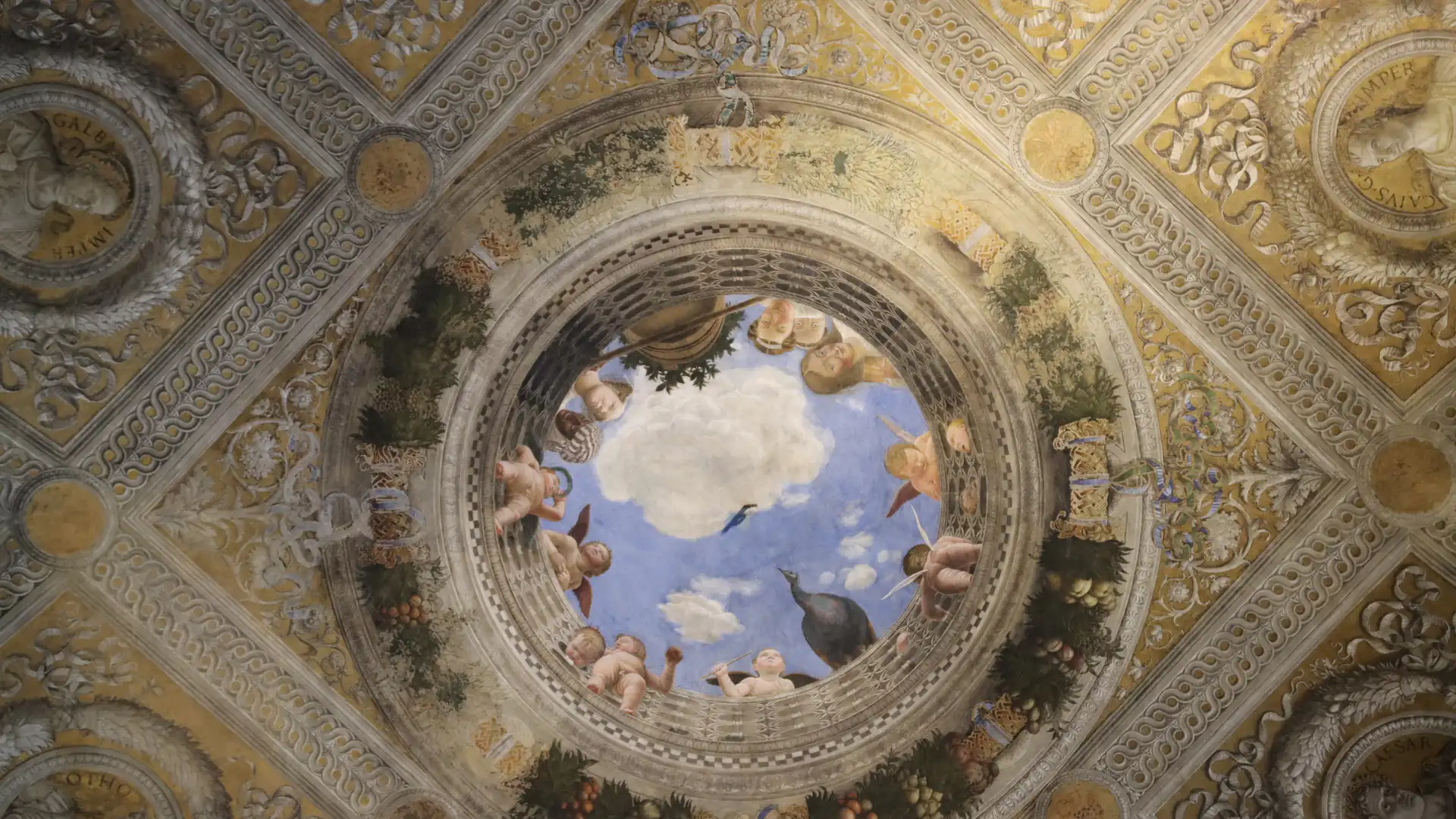
A few minutes' walk from Piazza Sordello brings you to two remarkable churches. The basilica of Sant'Andrea, begun in 1472 to designs by the great humanist architect Leon Battista Alberti, is one of the most influential buildings of the Renaissance: its huge triumphal-arch façade and vast barrel-vaulted interior set a template that echoes through later architecture. Inside, in the first chapel on the left, is the tomb of Andrea Mantegna, marked by a bronze bust of the painter, so you can pay respects to the artist of the Camera degli Sposi a short stroll from his masterpiece. The church also guards a relic said to be of the Precious Blood, central to Mantua's identity. Close by stands the Rotonda di San Lorenzo, a small round church from around 1100, sunk slightly below today's street level — the oldest church in the city, plain and moving after the grandeur of the basilica. Together they make an easy, rewarding loop from the palace. Sant'Andrea is not merely a fine church but a hinge in architectural history: Alberti conceived it as a deliberate revival of the grandeur of ancient Rome, and its single vast barrel vault, uninterrupted by aisles, became a model that architects studied and imitated for centuries. Standing beneath it, you feel the scale the Renaissance dreamed of. That Mantegna chose to be buried here, in the shadow of Alberti's masterpiece and a short walk from his own, ties the city's two greatest artistic minds together in one building. The little Rotonda di San Lorenzo nearby offers the opposite sensation — small, round, dim and ancient — and the contrast between the two, barely a hundred metres apart, is one of the quiet lessons of a Mantua visit.
The Teatro Bibiena and a young Mozart
One of Mantua's most delightful surprises is the Teatro Bibiena, or Teatro Scientifico, a small theatre completed in 1769 to designs by Antonio Bibiena. Where most theatres reach for grandeur, this one is intimate and curved, its walls of bell-shaped boxes swelling in warm wood and stucco, lit like a jewel. Its most famous evening came only weeks after it opened, when a thirteen-year-old Wolfgang Amadeus Mozart, touring Italy with his father, performed here in January 1770; Leopold Mozart pronounced the theatre the finest he had ever seen. It is still used for concerts today, and even empty it is enchanting — a reminder that Mantua's cultural life did not end with the Gonzaga. A visit takes only twenty minutes or so, and it slips neatly between the palace and the churches. If you enjoy music or simply beautiful interiors, do not miss it; it is one of those small places that people remember long after the grander sights have blurred. The Bibiena family were the great theatrical architects of their age, masters of illusionistic stage design, and this little hall distils their art into a permanent room where the audience is as much on display as any performer. That the young Mozart played its inaugural season gives it a touch of legend, but it would be worth seeking out regardless, simply as one of the most beautiful small interiors in Italy. Because a visit is short and the theatre sits between the palace and the churches, it is easy to fold into a morning's walking, and it makes a lovely change of key — intimate and warm after the grand scale of the Ducale. Check whether a concert coincides with your visit; hearing music in that space is a rare pleasure.
Onto the lakes and out to Sabbioneta
With a little more time, two excursions reward you. The first needs no planning: take a boat trip on the lakes that ring the old town. Small cruises set out from the lakeside near the centre and drift among lotus flowers in summer and birdlife year-round, giving you the classic view of the Palazzo Ducale and the skyline rising from the water — the way the Gonzaga themselves often arrived. The second is Sabbioneta, about half an hour south by road, a perfectly preserved 'ideal city' laid out in the late sixteenth century by Vespasiano Gonzaga as a small Renaissance capital of his own. Its grid of streets, its own ducal palace, its Teatro all'Antica by Scamozzi and its long gallery share Mantua's UNESCO listing and feel like walking into an architect's model brought to life. Together, the lakes and Sabbioneta round out the Gonzaga story beyond the city walls, and either makes a fine half-day beyond the palace. The boat trips are gentle and require no booking ahead in most seasons, making them an easy, restful way to end a day of walking and looking — and they hand you the postcard view of the palace and towers rising straight from the water. Sabbioneta rewards the more curious traveller: built almost from scratch by Vespasiano Gonzaga as the capital of his own tiny state, it is a rare chance to see an entire Renaissance vision of the ideal city realised at once, rather than accreted over centuries as Mantua was. Its theatre, palace and synagogue can feel almost eerily complete and quiet, a stage set with few actors. Together the two places bookend the Gonzaga story, from the great water-city to the pocket utopia one branch of the family built for itself.
A suggested one- or two-day plan
Here is a shape that works. On day one, book a mid-morning or early slot at the Palazzo Ducale and give it two to three hours, taking in the Camera degli Sposi, the Corte Vecchia and the Museo Archeologico. Break for lunch on one of the squares, then walk the short loop to Sant'Andrea, San Lorenzo and the Teatro Bibiena in the afternoon, finishing with an aperitivo as the light turns. If you have a second day, devote the morning to Palazzo Te and its Sala dei Giganti, then choose between a relaxed boat trip on the lakes or the drive out to Sabbioneta in the afternoon. This rhythm keeps the two demanding painted palaces on separate days, so neither tires you, and threads the smaller gems in between. Mantua is compact enough that nothing involves a long journey, and unhurried enough that you can adjust as you go. Tell us your dates and interests and we are glad to help you book the pieces and sequence them well. Feel free to flip the order to suit opening days and your own energy — the key structural rule is simply to keep the Ducale and Palazzo Te on different days, since two intensely painted palaces in a single day tend to blur together. Build each day around its fixed points (your timed Ducale slot on one, Palazzo Te's opening hours on the other) and let the smaller sights and meals flow around them. Because everything in Mantua is close, you can afford to be relaxed and even a little spontaneous, ducking into a church or a café as the mood takes you. If you would rather not plan the pieces yourself, tell us your dates and interests and we will help you sequence and book the ones that need it.
Practicalities: staying and eating in Mantua
Mantua makes an easy and atmospheric overnight base. Staying in or near the historic centre lets you enjoy the city once the day-trippers have left, when the squares empty and the lakeside glows. The local cuisine is a real reason to linger: this is the home of tortelli di zucca, plump pasta parcels of sweet pumpkin, amaretto and mostarda, and of hearty dishes like risotto alla pilota and slow-cooked meats, washed down with the sparkling red Lambrusco of the surrounding plains. Book a table at a traditional trattoria and you eat very well for modest prices. Getting here is simple by train from Verona, and the flat centre is best explored on foot or by bicycle. If you are pairing Mantua with Verona, Milan or Venice, it works beautifully as a calm counterpoint to those busier cities. Whatever shape your trip takes, securing your Palazzo Ducale slot first gives the visit its anchor, and everything else can be arranged around that fixed, unmissable hour with Mantegna. If you can, time your visit to catch the city at its best — spring and autumn for the mildest weather, or the atmospheric shoulder days either side of the September literature festival, when Mantua fills with readers and writers. Book accommodation in the historic centre and you will find the evenings especially magical, the floodlit palaces reflected in near-empty streets. And do give the local table its due: Mantuan cooking is one of the glories of the Lombard-Emilian plain, generous and a little sweet, and lingering over it is not a distraction from the sightseeing but part of the point. Anchor the trip with your Palazzo Ducale slot, eat and wander well around it, and you will leave with the rare feeling of having seen a great city properly rather than merely ticked it off.
Frequently asked
Is Mantua worth an overnight stay?
Yes. Mantua is a compact, beautiful Renaissance city ringed by lakes, quieter than Verona or Venice, with the Palazzo Ducale, Palazzo Te, fine churches and excellent food. An overnight lets you enjoy the centre after the day-trippers leave.
How do I combine the Palazzo Ducale with Palazzo Te?
They are separate sites with separate tickets, about a twenty-minute walk apart. Many visitors do the Ducale on one day and Te on the next to avoid painting fatigue. Ask us and we can help you plan and book both.
What is Sabbioneta and is it far?
Sabbioneta is a late-16th-century planned 'ideal city' built by Vespasiano Gonzaga, about half an hour south of Mantua by road. It shares Mantua's UNESCO World Heritage listing and makes a rewarding half-day excursion.
Where is Andrea Mantegna buried?
In the basilica of Sant'Andrea in Mantua, a short walk from the Palazzo Ducale, in the first chapel on the left, marked by a bronze bust — close to the Camera degli Sposi he painted.